1. Page Purpose
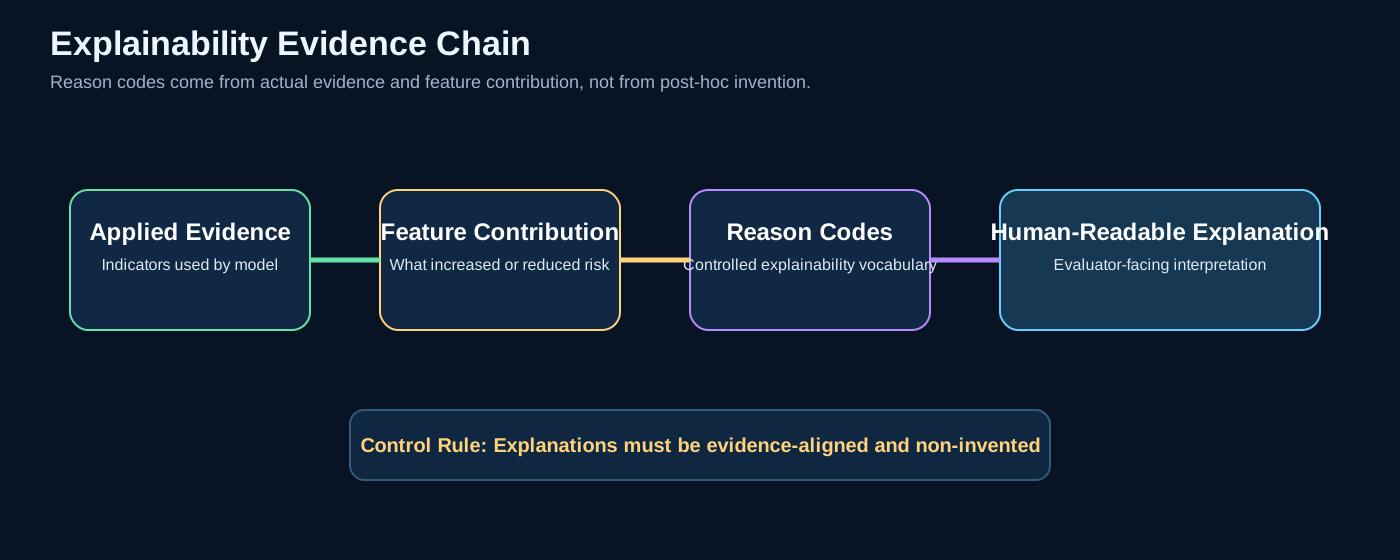
Explainability converts model-applied evidence into reason codes, feature contributions and a human-readable explanation so the assessment can be inspected and challenged.
The key governance rule is evidence alignment: a reason may be shown only when it corresponds to evidence actually applied by the model.
2. Why This Capability Exists
EXPLAIN — Reason Codes exists because a trustworthy cross-system payment assessment platform must make each material responsibility explicit. A page should not merely display information; it should show which system capability produced the information, what evidence was used, what versioned component was involved and what the downstream consequence is.
The TRUST design deliberately separates integration, normalization, evidence derivation, AI inference, explanation, policy, audit and institutional authority. This prevents one opaque component from silently performing multiple responsibilities and makes the overall result easier to reproduce, test and govern.
3. Where This Page Fits
The page sits within the end-to-end TRUST SDK assessment lifecycle. Upstream components provide controlled transaction context and downstream components consume the resulting evidence. The exact stage differs by page, but the architectural rule remains constant: data and responsibility move forward through explicit boundaries rather than through hidden coupling.
The final operational decision remains outside the TRUST analytical chain. TRUST can advise, explain and record evidence, but the participating institution retains final authority over its transaction.
4. Functional Responsibilities
- Present the evaluator-facing capability represented by EXPLAIN — Reason Codes in a form that can be inspected and understood.
- Expose the relevant operational, technical or evidential information without mixing unrelated component responsibilities.
- Preserve linkage to upstream and downstream stages so an evaluator can follow the complete chain.
- Retain version, provenance and decision-boundary information wherever the capability influences trust, risk or policy interpretation.
- Fail safely when source evidence is missing, invalid or unsupported instead of inventing a result.
5. Inputs
- Validated demonstrator evidence appropriate to the capability.
- Page-specific runtime, integration, model, policy, telemetry or audit context.
- Versioned implementation metadata needed for reproducibility.
- Transaction, assessment or correlation identifiers where relevant.
- Explicit missing-value or unsupported-data indicators where evidence is incomplete.
6. Processing Logic
- Load only the controlled evidence required by the capability.
- Validate that the required source evidence is present and structurally usable.
- Transform the evidence into human-readable and machine-consistent outputs.
- Preserve identifiers, version information and provenance across the transformation.
- Expose failure or insufficiency explicitly rather than fabricating missing evidence.
- Hand the resulting output to the next governed stage.
7. Outputs
- Evaluator-facing interpretation of the capability.
- Status, metrics, evidence, explanations, reports or controls appropriate to the page.
- Version/provenance information where applicable.
- Contextual links into related TRUST SDK capabilities.
- A result that remains inside the defined institutional decision boundary.
8. Data & Evidence Interpretation
Reason codes identify the factors that materially explain the model result. They are not generic fraud labels.
Feature contributions show the relative influence of evidence on the model result. They support traceability but should not be treated as independent transaction decisions.
The human-readable explanation is a presentation layer over the same evidence; it must not introduce unsupported claims.
9. Technical Notes
- The implementation favors deterministic, version-aware processing so the same controlled evidence can be replayed and checked.
- The UI is intentionally evaluator-facing. It should expose enough technical depth to prove the architecture without requiring the evaluator to inspect raw implementation source code.
- Where a machine-readable JSON artifact exists, the UI presents its meaning in human-readable form while preserving a traceable link to the underlying evidence.
10. Failure Modes & Safe Failure
- Unsupported reason generated after scoring: reject the explanation.
- Feature contribution unavailable: disclose that the contribution evidence is unavailable rather than inventing it.
- Explanation/model mismatch: flag the assessment for review.
- Stale reason-code registry: version and reconcile before presentation.
11. Evaluator Verification Checklist
| Evaluator question | Expected evidence |
|---|
| Is the capability clearly bounded? | The page and manual should state what the component does and what it explicitly does not do. |
| Is source evidence visible? | The capability should identify or link to the evidence used to produce the displayed result. |
| Is version information available? | Model, SDK, policy, adapter or implementation version should be available where relevant. |
| Can the result be reconstructed? | Identifiers and upstream/downstream evidence should make replay or reconstruction possible. |
| Does the component fail safely? | Missing or unsupported evidence must not be converted into invented facts. |
| Is institutional authority preserved? | TRUST may advise, but final transaction authority remains with the institution. |
12. Evidence Sources
- Page-visible runtime or assessment evidence.
- Related technical and evidence-chain pages.
- Model / policy / SDK registry information where applicable.
- Audit references or telemetry where applicable.
- Web/PDF reporting artifacts generated from the same controlled evidence.
13. Governance & Decision Boundary
TRUST is an advisory assessment capability. It does not independently authorize, settle or block a payment.
The participating institution retains final transaction authority and remains responsible for institution-specific compliance, operational policy and production controls.
The demonstrator uses synthetic or controlled evidence and should not be described as production certification.
14. Example Evaluator Walkthrough
- Start from the page's principal status or result.
- Identify the transaction, assessment, component or evidence source behind that result.
- Follow the related contextual page to inspect the upstream evidence.
- Verify the component/version that generated the output.
- Follow the downstream path to explanation, policy, audit or report evidence as applicable.
- Confirm that the displayed recommendation remains advisory and that the institution remains the final decision maker.
15. Acceptance / Readiness Criteria
- The page loads successfully and exposes the intended capability.
- Displayed values reconcile with controlled evidence.
- Relevant version/provenance information is inspectable.
- Contextual navigation reaches upstream/downstream stages.
- Failure states are explicit and non-fabricating.
- Institutional decision authority is clearly preserved.
16. Related Page Sections / Continue Reading
- Purpose in the demonstrator
- Operational meaning
- Inputs and outputs
- Evaluator questions this page answers
- How this stage fits in the end-to-end chain
- Governance and interpretation notes
- Explainability Evidence Chain
- Page purpose
- What this page contains
- How to use this page
- Key points to understand
- Evaluator interpretation
- Governance note